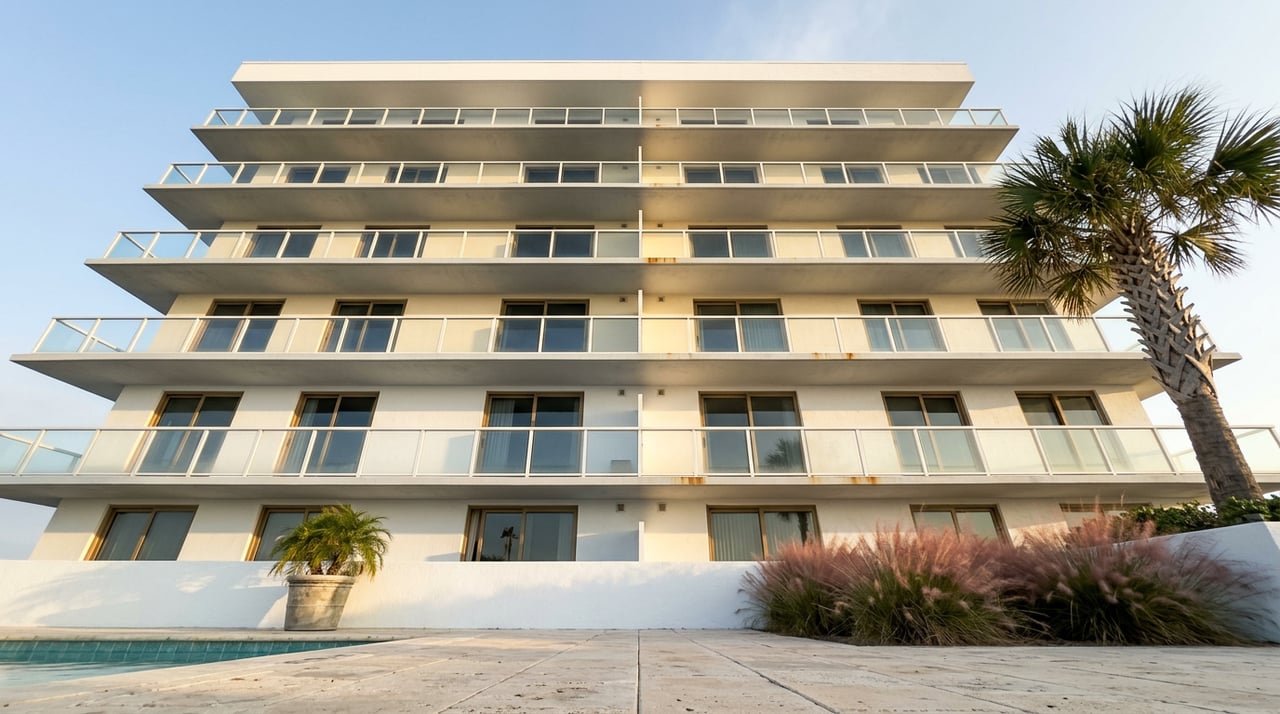
Shoreline Towers sits at the start of Holiday Isle, three twelve-story buildings that went up in 1974 as Destin's first high-rise condominiums. Between 2022 and 2023, the association pushed through a top-to-bottom renovation: new hurricane-rated windows and doors, a new roof, resurfaced concrete in the parking garages and stairwells, replaced stucco. The bill for that work landed on owners as a special assessment of roughly $70,000 per unit, one of the largest seen on the Emerald Coast.
That project is finished. Right now, according to the building's own rental notices, Shoreline Towers is about to start again. A complex-wide waterproofing project begins September 14 and runs into next spring, hitting different buildings in sequence with scaffolding, construction noise, and dust, though the notice says beach access won't be affected.
A reasonable buyer might look at that timeline and conclude Shoreline Towers already paid its dues. It did the big fix. The building passed through its reckoning years ago. What that timeline actually shows is something less comforting: even a fifty-year-old tower that already absorbed a seven-figure assessment keeps generating new capital projects, because reserve funding in Florida isn't a one-time event. It's ongoing, and 2026 is the year the rules around it changed for every building on this coast, not just the ones that already had their moment.
Two Documents, Two Different Questions
Buyers touring an older Destin condo usually ask one question: has the building passed its milestone inspection? It's the right question, just not the only one, and increasingly not the one that decides whether a purchase turns expensive after closing.
The milestone inspection, created by Senate Bill 4-D after the 2021 Champlain Towers South collapse, is a structural opinion. A licensed engineer walks the building and reports whether load-bearing walls, the roof, and other structural components show substantial deterioration. Buildings that had already reached 30 years of age (or 25 in coastal jurisdictions that adopted the earlier trigger) before July 2022 were required to complete that first inspection by December 31, 2024. Buildings that crossed the threshold between mid-2022 and the end of 2024 had until December 31, 2025. For most of Destin's pre-1994 gulf-front inventory, that deadline has already come and gone. A "clean" report just means an engineer didn't find deterioration serious enough to trigger a second phase.
The Structural Integrity Reserve Study, or SIRS, is a different question entirely. It's a financial opinion: given the condition of the roof, the plumbing, the waterproofing and the rest, how much money does the association need in reserves, and is it actually there? For years, associations could vote to waive or underfund these reserves to keep monthly dues low. That loophole is what closed in 2026. The Florida Department of Business and Professional Regulation says that associations with budgets adopted after December 31, 2024 can no longer vote to waive SIRS reserves, and full funding at the level the study recommends was required to begin January 1, 2026.
A building can pass its milestone inspection with flying colors and still walk into 2026 with reserves nowhere near what the SIRS says they need. Those are two separate documents answering two separate questions, and only one of them tells a buyer anything about the check they might be asked to write soon after closing.
Why This January Mattered More Than the Building's Birthday
The milestone inspection law got the headlines because it followed a tragedy. The reserve-funding requirement is quieter, but it's the one actually reshaping monthly costs and assessment risk on the Emerald Coast right now. For decades, keeping dues artificially low by underfunding reserves was standard practice at plenty of Florida associations. That practice is no longer legal.
What that means in practice: a building that never had a dramatic renovation like Shoreline Towers' 2022 project can still be sitting on a reserve shortfall that only becomes visible, and mandatory to fix, in 2026. That exposure doesn't show up on a listing sheet. It shows up in the SIRS and the current budget.
There's a financing wrinkle too. Nasseh Law reports that lenders are now scrutinizing a building's reserve position and inspection status as part of underwriting. GoverningDocs reports that a noncompliant association can lose access to conventional financing altogether, sometimes landing on a list that blocks loans for every unit in the building. A deal that looked simple at contract signing can stall late in the process if nobody checked this earlier. It's one more reason the reserve documents deserve the same attention as the price per square foot.
The Age Band Nobody's Selling Point Mentions
Shoreline Towers isn't an outlier inside Destin's city limits. Public building records show several of Destin's own Gulf and harbor-front addresses landing in the same age band, all built decades before this year's reserve-funding requirement existed:
| Building | Location | Built | Age in 2026 |
|---|---|---|---|
| Valencia | Destin Harbor, Calhoun Ave | 1972 | 54 |
| Shoreline Towers | Holiday Isle | 1974 | 52 |
| Jetty East | Holiday Isle | 1975 | 51 |
| Century Park West | Destin Harbor, Indian Trail | 1976 | 50 |
| Islander | Holiday Isle | 1984 | 42 |
Every one of these is already past the statewide default 30-year milestone-inspection threshold. Whether the earlier 25-year coastal trigger also applies to any of them is a determination local building officials make, not an automatic statewide rule, so it's worth confirming rather than assuming. The same construction era continues just west of Destin along Miramar Beach's Scenic Gulf Drive corridor, where buildings like Crystal Villas, Cabana Club and Green Reef date to the early-to-mid 1980s. That's a separate neighborhood with its own inspection and reserve timeline, but the underlying pattern repeats: a lot of this coastline was built before anyone had to fund a SIRS, and now everyone building on it does.
What to Ask Before You Write an Offer
If you're evaluating a Destin condo built before the mid-1990s, the milestone inspection summary is table stakes. Ask for it, but don't stop there. The documents that actually predict your exposure are the current SIRS or reserve study, the percentage funded against what that study recommends, the last two to three years of financials, and a written history of special assessments including how each one was paid. Florida law generally requires an association to produce an estoppel certificate within a set period of a written request, and the Condominium Act also gives buyers a short review window, typically three business days, once those documents are actually in hand. That window is easy to miss if the request for documents goes out late in the contract period rather than the day it opens.
It's also worth asking what the association's hurricane deductible looks like relative to its current reserve balance. A deductible set as a percentage of insured value can run into six figures on a single building.
A Few Questions Worth Settling Before You Close
If a building's milestone inspection came back clean, does that mean its finances are fine too? No. The inspection answers a structural question. Whether the association is fully funding reserves under the 2026 requirement is a separate financial question, answered by the SIRS and the current budget, not the inspection report.
How do I find out if a specific Destin building falls under the earlier 25-year coastal trigger instead of 30? That determination is made locally. Okaloosa County's Growth Management department, which oversees building safety compliance countywide, is the right first call to confirm which timeline applies to a given address.
What if the seller can't produce a current SIRS? Treat that as a flag worth investigating rather than a dealbreaker. Ask why, ask when one is scheduled, and factor the uncertainty into your offer and your financing timeline before you're locked into a short inspection period.
Buying an older Gulf-front condo in Destin still makes sense for plenty of buyers. It just makes sense with the right two documents in hand, not one. If you're comparing buildings along Holiday Isle, Crystal Beach, or anywhere else on this stretch of coast and want help reading a SIRS and a reserve budget before you write an offer, or need financing lined up alongside the search so a reserve question doesn't stall your closing, John Baldree can walk through both sides of the transaction with you. Let's Connect.
This article is general information, not legal, tax or financial advice. Consult a qualified professional about your situation.